

The Irresistible Change® newsletter is about organizational culture, transformation, and design. It’s written for executives who recognize that tools and methods come and go, but it’s culture that drives sustainable, differentiated outcomes. And that the status quo is a culture’s mortal enemy.
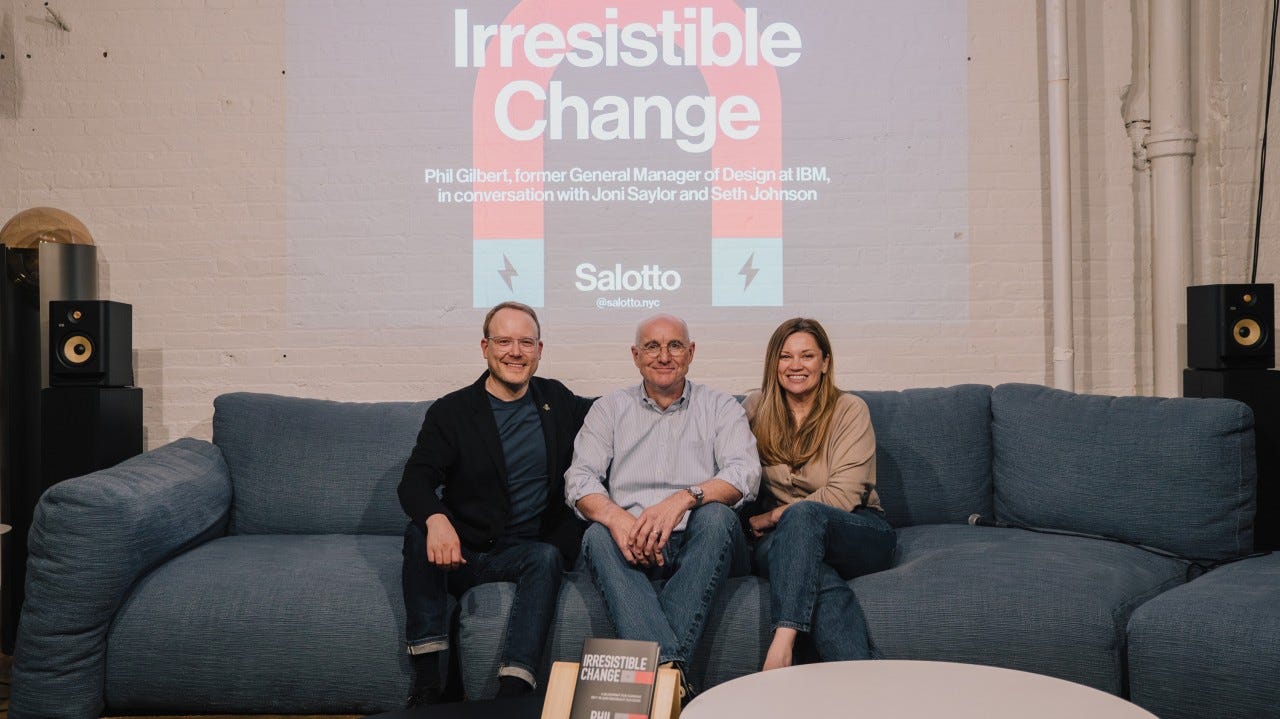
This is the 1st of a series of reflections on the launch events for my book, Irresistible Change: A Blueprint for Earning Buy-In and Breakout Success. You can learn more about it here.
On Wednesday, Nov. 12, at Salotto.nyc, I shared an unforgettable evening in Brooklyn’s premier design salon, where the conversation turned to what it really means to make design count inside the enterprise. Along with Joni Saylor, Seth Johnson and Gabriele Rossi, I shared a perspective on something I’ve been asked for years: “How do designers get a seat at the table?” In my experience, the biggest gap isn’t craft. It’s not talent, or aesthetic, or even process. It’s how designers communicate their value to the rest of the organization.
Too often, the impulse is to explain why “design is important.” But inside an enterprise, evangelism isn’t what earns power — the value of your work does. While we might hope that work speaks for itself, it doesn’t. We need to translate. And the truth is, many designers only know how to communicate as designers, great in rooms full of people who already understand design. But in front of skeptics, or simply colleagues with different incentives, we default to a design-centric pitch that misses the mark.
My view is simple: the most effective designers learn to speak business as a second language. Not to dilute the craft, but to amplify its relevance by presenting it in the context of the the business it’s a part of. This makes it intelligible and influential where it matters.
While leading the transformation of IBM, here’s one of the many things my team did to help establish this language, excerpted from the book:
[We] developed intensive exercises to help designers understand their unit’s business strategy and tactical challenges. We even created an innovative way to make business fundamentals more engaging: a quarterly video conference that broadcast live IBM’s earnings calls. Inspired by the cult TV show “Mystery Science Theater 3000,” we assembled a panel of business-savvy designers alongside experts from our chief financial officer’s office and other business divisions to provide real-time interpretation of the earnings call for our global audience. This unique format made the language of business accessible and even entertaining for everyone.
This deeper understanding of IBM’s business transformed how designers approached their work. They learned that the path to having a seat at the table wasn’t just through design excellence, but through understanding and engaging with the full spectrum of business challenges and communicating their work in the context of the current business environment.
As a follow-on question, someone asked what advice I’d give to people considering a career in design. There are a hundred ways to answer that question, but I simply shared what I would do if I had a new life in front of me:
“I’d get an undergraduate degree in Economics at the University of Chicago, and then an MFA in Design from a school that fit my needs.”
Yesterday, I received a DM from someone who loved that answer but they were well past the student stage and asked instead: “What economics books would you recommend?”
It caught me a little off guard.
What I value about Economics has never been the formulas or models. It’s that Economics is the most expansive of the “business” disciplines. It comes closest to Arts and Literature. It cultivates a creative mindset — one that requires you to think in systems, understand incentives, and make sense of complexity. It’s the art of business, if you will.
So my book recommendations aren’t Economics 101. They’re the books that get to the spirit of what I meant, not the literal course list. They speak to the systems of power which must be the domain of design. And while I’m sure I’ll forget ten that are better, here are the ones I still have on my bookshelf today…
Against the Gods: The Remarkable Story of Risk - Peter L. Bernstein
Dealing with Darwin: How Great Companies Innovate at Every Phase of Their Evolution - Geoffrey A. Moore (really anything by GAM. Crossing the Chasm, etc. but Dealing with Darwin always especially stuck with me)
Take on the Street: What Wall St. and Corporate America Don’t Want You to Know / What You Can Do to Fight Back - Arthur Levitt
The Paradox of Choice: Why More Is Less - Barry Schwartz
And one that’s really off the wall but I fit squarely in the “this is the economic history of the western world”... The three volume series The Baroque Cycle: Quicksilver, The Confusion, and The System of the World - Neal Stephenson
Enjoy your winter reading (starting with my book!). And remember, design gains power not by insisting on its importance but by meeting the organization on its own terms. Only then can you hope to reshape those terms, and establish design’s proper role and influence.